

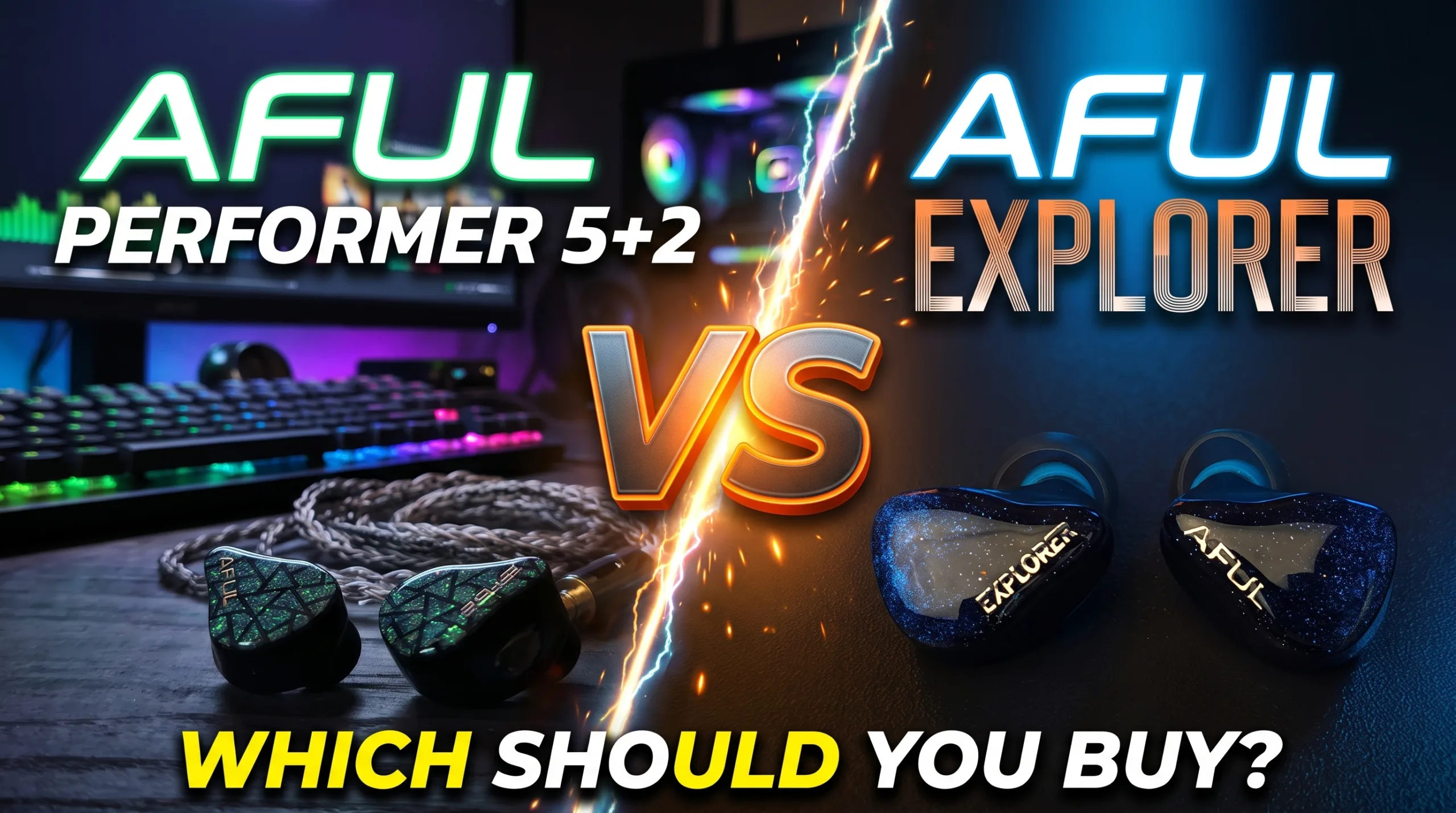
Two of AFUL’s most-discussed IEMs sit exactly $120 apart. The Performer 5+2 lists at $239.99 and packs seven drivers per side: two dynamic, four balanced armature and one micro-planar. The Explorer lists at $119.99 with three: one dynamic and two balanced armature. It would be easy to read that as “more drivers, better sound”, and that is not what I heard.
After weeks with both, the useful question is not which is better. It is which sound you want in your ears every day. The Performer 5+2 is cleaner, brighter and more spacious, with sharper imaging and treble that has some edge. The Explorer is warmer, darker and denser, with thick bass and treble that stays out of your way. I covered each one in my detailed AFUL Performer 5+2 review and my AFUL Explorer review, but neither puts them next to each other for someone with one budget and one decision to make. This guide does.
Quick Verdict
The Performer 5+2 is the better technical performer. The Explorer is the easier one to love.
- Buy the Performer 5+2 if you want a clean, spacious, lively sound with strong separation and clear vocals, and you can live with some grit on cymbals and hi-hats.
- Buy the Explorer if you want thick, warm bass, a relaxed upper midrange and treble you can listen to for hours, and you would rather keep the extra $120.
- Look elsewhere if you want a warm-neutral, vocal-friendly sound, because neither is that. My Truthear Hexa review covers the set I would pick myself for that sound.
I scored the Performer 5+2 8.5/10, and I called the Explorer my favorite AFUL to date. Those two statements do not contradict each other. The 5+2 is the more technically capable set, and the Explorer is the one I reach for when I want to relax.
I ran both IEMs side-by-side over several weeks. The Explorer served as my daily driver (including overnight sleep tests), while the Performer 5+2 was tested across repeated critical listening sessions.
- Sources: $10 Apple USB-C dongle (3.5mm) on mobile, plus desktop DAC/amp.
- Fit & Reference: SoftEars Ultra Clear tips; Parcels’ Games of Luck (live) for attack, space, and cymbal texture.
- Measurements & Gaming: Frequency response verified on my coupler rig. Dedicated competitive gaming sessions (CS2, Valorant, Apex Legends) were run strictly on the Explorer.
AFUL Performer 5+2 vs Explorer Specifications
| Spec | AFUL Performer 5+2 | AFUL Explorer |
|---|---|---|
| Also sold as | Performer 7 | None |
| Drivers per side | 2 dynamic (6 mm) + 4 balanced armature + 1 micro-planar | 1 dynamic (8 mm biocellulose) + 2 balanced armature |
| Impedance | 15 ohm ±20% | 26 ohm ±10% |
| Sensitivity (as listed) | 109 dB at 1 kHz | 108 dB/mW |
| Listed frequency response | 10 Hz to 35 kHz | 10 Hz to 30 kHz |
| Shell | 3D-printed resin, semi-custom, medium to large | 3D-printed resin, semi-custom, medium-small |
| Connector | 0.78 mm 2-pin | 0.78 mm 2-pin, flush |
| Cable | 1.2 m, soft 8-wire braid, silver-plated copper | 1.2 m, 200-core dual-strand silver-plated copper, slightly thicker |
| Plug | 3.5 mm or 4.4 mm, chosen at purchase | 3.5 mm or 4.4 mm, chosen at purchase |
| Ear tips included | Three sets of silicone | Two sets of silicone |
| Case | Semi-hard puck | Zippered soft-touch case with mesh pocket |
| Nozzle | Narrow, no lip, no mesh | No lip, no mesh |
| Noise reduction | Passive isolation only, no ANC | Passive isolation only, no ANC |
| List price | $239.99 | $119.99 |
| Price in my reviews | About $239 to $240 | $119.99 (about $120) |
| HiFiGo price when checked (Oct 30, 2026) | $234.99 | $114.99 |
Sources: AFUL’s distributor HiFiGo for driver counts, impedance, sensitivity, frequency response, connectors and plugs, plus my own reviews for shell size, accessories and cable feel. Two notes. First, the sensitivity figures use different units on the listings, so the 1 dB gap means nothing in practice. Second, frequency-response ranges on spec sheets say very little about how an IEM actually sounds. “Performer 5+2” and “Performer 7” are two names for the same product, so a store listing either name is selling this IEM.
Price & Value
At list price the 5+2 costs exactly double. The gap stays near $120 at retailers too, since HiFiGo had them at $234.99 and $114.99 when I checked. Prices move, and HiFiGo currently runs an 11.11 and Black Friday sale section, so check before you buy. I cannot promise discounts.
What the extra money gets you: four more drivers on paper, but more usefully a different and more technical presentation. In my listening that means cleaner separation, sharper imaging, better detail on busy tracks and more treble air. You also get a third set of ear tips. What it does not get you is a bigger version of the Explorer’s sound. The Explorer is warmer, bassier and smoother, and in some ways that is the more relaxing listen.
My view: The 5+2 earns its premium only if you will actually use its superior separation and vocal clarity. If you mostly want warm, punchy, fatigue-free listening, the Explorer already delivers that for half the cost, and for many listeners it is the smarter purchase.
Build Quality, Fit & Comfort
Both shells are 3D-printed resin with a semi-custom shape, but they fit very differently.
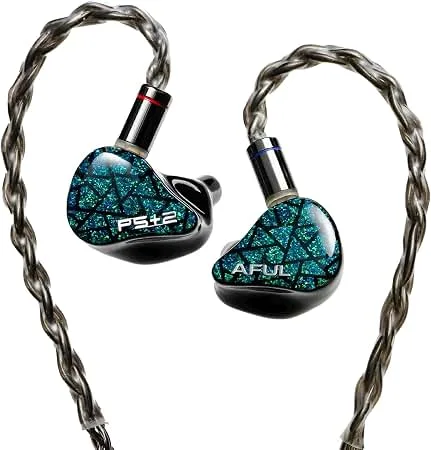
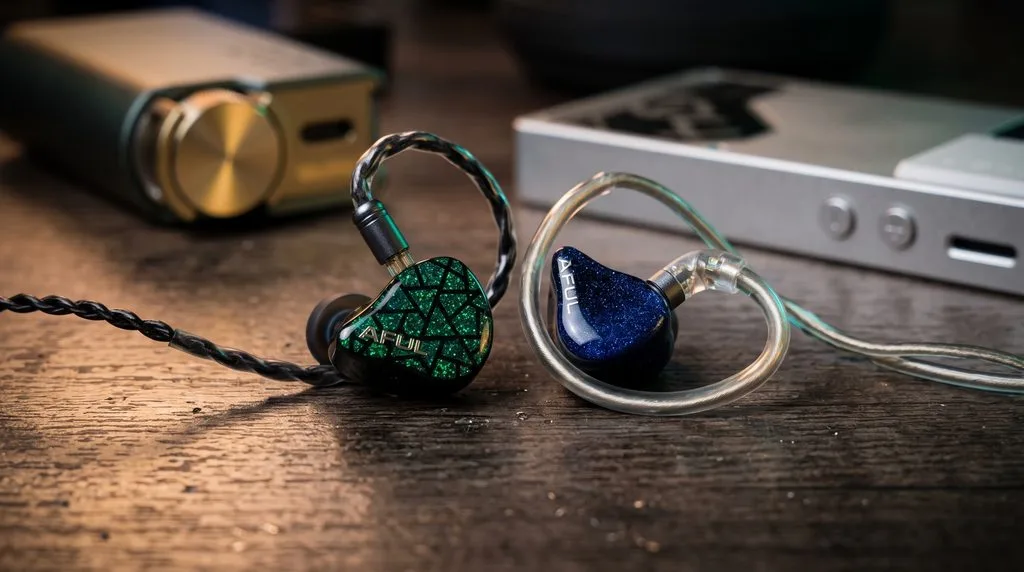
The Performer 5+2 is a medium-to-large shell, slightly bigger than the original Performer 5. Finish is very good, and the green-and-blue faceplate shifts colour with the light. Once I found the right tip it stayed put and sealed well, the contours sit naturally behind the ear folds, and I wore it overnight without it moving. It is still a sizeable shell, and its narrow nozzle sits a fair distance from the body, so it can feel slightly long front to back depending on your ear.
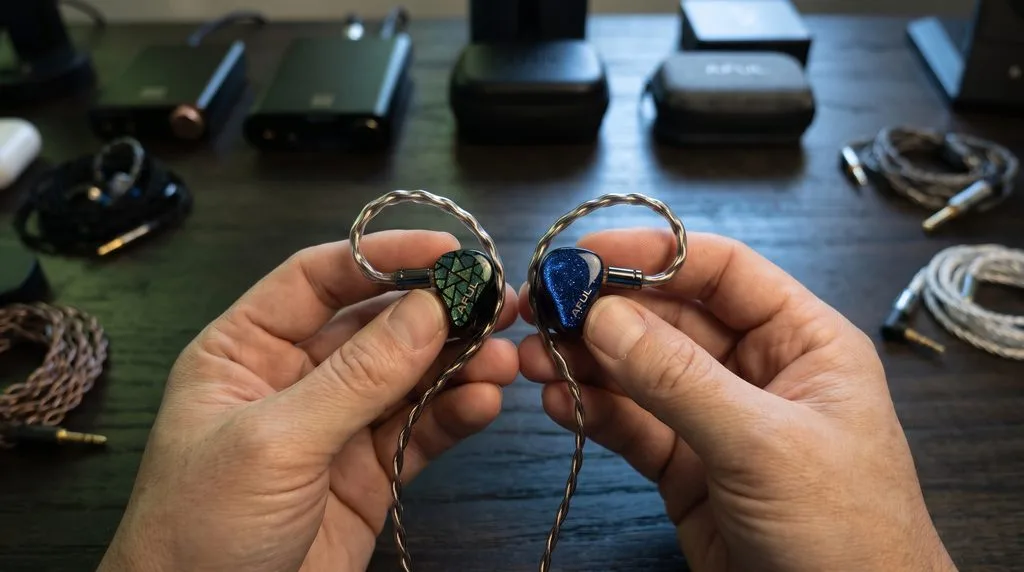
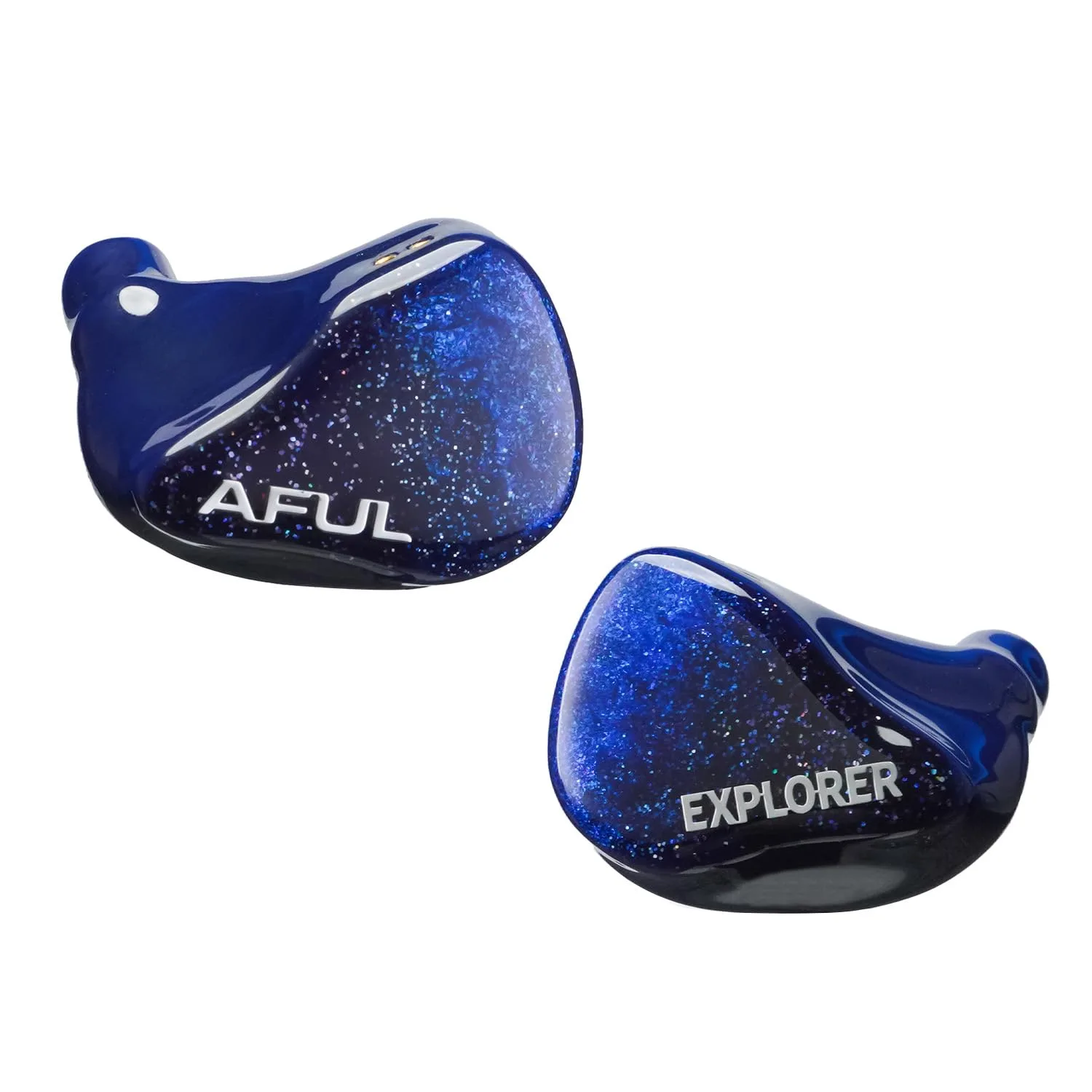
The Explorer is the smaller, lighter one. It is medium-small and did not crowd my concha bowl or create hot spots. The semi-custom molding kept it locked in even while sleeping, which I do often with IEMs. If you have small ears or sleep in your IEMs, start here.
Ear tips. Neither nozzle has a lip, so a smooth tip can slip. SoftEars Ultra Clear tips, which are grippy, gave me the most secure fit on the 5+2. On the Explorer, if the stock tips feel loose, I would try grippy aftermarket tips such as SpinFit CP100+ or DUNU S&S. Both nozzles also leave their openings exposed, with no mesh on the Explorer, so keep your ears clean to protect the filters.
Cable & Accessories
Neither package has a meaningful sonic advantage. The differences are practical.
The Performer 5+2 cable is soft and flexible with a pleasant drape, a small Y-split, a chin cinch that stays in place and pre-formed ear hooks. The braid can look a little uneven after wrapping, which is cosmetic, and the hooks are larger and straighter than I like but caused no fit problem. You get three sets of silicone tips and a compact puck-style case, which is one of my favorite parts of the package. It is small, closes securely and gives reasonable protection.
The Explorer cable is slightly thicker and barely holds memory. Its chin cinch is one of the best I have used, the Y-split hardware is small, and the flush 2-pin connectors work with almost any aftermarket cable. The package includes two sets of silicone tips and a zippered, soft-touch case with a felt lining and a mesh pocket for spare tips. For $120, the accessories punch above the price.
So the 5+2 gives you one more set of tips, and the Explorer gives you the nicer case. Both cables are non-modular, which means you pick 3.5 mm or 4.4 mm when you order. I would choose 3.5 mm unless you already own a 4.4 mm source.
Sound Quality
The Performer 5+2 sits between neutral and V-shaped. It has a clean midrange, a noticeable bass lift and extra lower-treble energy, which I would call a mild V. The Explorer is a warm, bass-dominant set with a noticeably relaxed upper midrange and a smooth top end. On the graph its treble looks rolled off, though it did not sound that way to me.
The way they handle the upper mids and lower treble is the real dividing line. That is the region that gives vocals their definition and cymbals their snap. The 5+2 puts energy there. The Explorer pulls it back and spends the energy on bass. HiFiGo’s product description says AFUL reused the crossover and 3D-printed acoustic tube techniques it developed for the Performer series and the MagicOne. That is why I read the difference as tuning, not driver count.
| Dimension | Performer 5+2 | Explorer |
|---|---|---|
| Overall balance | Neutral to mild V; clean mids, lifted bass, extra lower treble | Warm and bass-dominant, slightly dark-leaning |
| Bass | Punchy, fast, controlled | Thick, weighty, rumbling |
| Vocals | Clean and present | Relaxed, set slightly back |
| Treble | Airy and energetic, slightly gritty on cymbals | Smooth, controlled, easy |
| Staging | Wider, with better lateral separation | More compact, with front-to-back depth |
| Long-session ease | Easy for most; harder if treble-sensitive | Very easy |
Bass Comparison
Both go low enough to give you real physical rumble, and neither smeared the midrange in my listening. The difference is in how the bass behaves.
The Explorer is the bassier of the two. Its low end is warm and dense, with sub-bass rumble plus a fuller mid-bass that gives kick drums a solid, satisfying hit without bleeding into the rest of the mix. That fullness has a cost, which I noticed in CS2, where the elevated mid-bass warmth sometimes masked faint footsteps.
The Performer 5+2 puts its bass lift below roughly 200 to 300 Hz, and what stood out was speed. Notes start quickly and stop cleanly, bass guitar has real weight, and electronic low end carries enough rumble to feel exciting without muddying the midrange. The second dynamic driver seems to give it that physical snap, though I would not credit the driver count alone. AFUL says its dual-dynamic section and Y-shaped bass duct are meant to add elasticity and density.
My view: bass lovers who want weight and warmth should lean Explorer; people who want bass with speed and clean separation should lean 5+2.
Midrange & Vocals
This is where the two diverge most clearly in daily listening.
The Performer 5+2 has a clean, fairly open midrange. A touch of lower-mid warmth gives male vocals body without making them thick, and female vocals come through clear and forward with extra presence from the upper-mid and lower-treble tuning. It is not a shy vocal IEM, and it is not pushed so far forward that instruments lose room. Guitars, keyboards and strings tend to sit in distinct positions instead of blending into one dense block.
The Explorer puts vocals on the relaxed, pulled-back side. Its warm, lush midrange blends smoothly into the instrumental mix, which is lovely for easygoing listening and less ideal for a singer you want front and center. I would not choose it for vocal-centric acoustic tracks. Instruments get thickness and body, while the 5+2 gives them cleaner outlines.
Treble & Listening Fatigue
Treble is where the two sets make their different trade-offs most obvious.
The Performer 5+2 has good upper-treble extension, audible sparkle and a sense of air around instruments. I did not hear obvious sibilance, and it stayed controlled enough for long sessions. Its weakness is texture: cymbals, hi-hats and brushes can sound slightly gritty or plasticky. You notice it most after switching from smoother IEMs. I would not call it harsh, but I would call it coloured.
The Explorer is the smooth one. The graph looks rolled off, yet it never sounded dull to me, because the pulled-back upper mids stop competing with the treble and let it come through with more presence than the graph suggests. There is enough crisp sparkle to define transients without harshness or sibilance. In the gaming sessions I covered later, that smoothness let me play three-hour ranked sessions with no ear fatigue.
My view: If you are treble-sensitive or prefer long listening sessions at sensible volume levels, the Explorer’s smoother treble may be more comfortable. If you prefer extra air and extension, the Performer 5+2 offers more of both.
Soundstage, Imaging & Separation
This is the clearest place where the extra money buys something.
The Performer 5+2 has an above-average soundstage for the price, with good width. Imaging is one of its best qualities: instruments have clear left-to-right positions, and layering holds up in dense arrangements. Its strength is clarity and lateral organization, not height or deep three-dimensionality, and it is easier to follow individual parts than on the warmer, denser Explorer. Detail retrieval is very good for the price, and transient attack is a particular strength.
The Explorer does not project the widest left-to-right image, because it has no bright airy treble boost to open things up. What it does have is front-to-back depth, from fast transient response and a weighty low end. The result feels full and dimensional, but compact next to the 5+2.
My shorthand: the 5+2 is wider and better separated; the Explorer is deeper and more intimate.
Isolation. Neither IEM has active noise cancellation. Both rely on passive isolation, so the tip seal decides how much outside sound you lose. I found the Explorer isolates aggressively. Its front vent for the dynamic driver prevented pressure build-up for me, though the tight seal can add a stronger occlusion effect if you are sensitive to that. I did not record a separate isolation note for the 5+2.
Which One Is Better for Gaming?
I have to be careful here, because my testing is uneven.
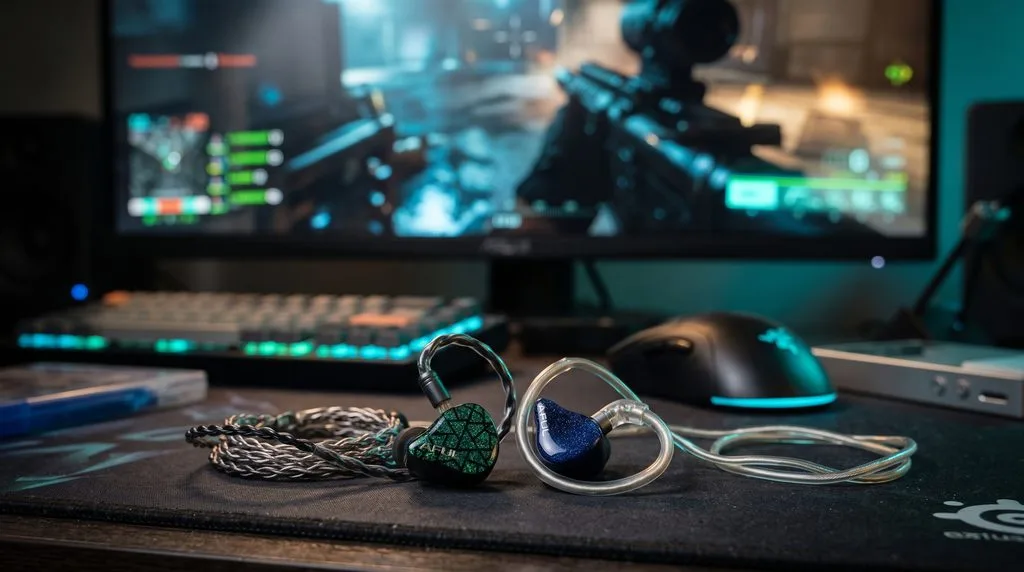
What I tested. I logged multiple evenings with the Explorer in Counter-Strike 2, Valorant and Apex Legends. Its secure, zero-fatigue fit and non-strident treble made it easy to wear for marathon sessions. In Valorant and Apex Legends the smooth treble let me play three-hour ranked sessions with no ear fatigue. In CS2 on Mirage, grenades and AWP shots sounded full and punchy without piercing my ears. The catch: the elevated mid-bass warmth occasionally masked faint footsteps near A-site Ramp during chaotic firefights, and its narrower left-to-right width makes long-range directional tracking less clinical than brighter sets.
What I did not test. I did not run dedicated CS2, Valorant or Apex sessions with the Performer 5+2. Its imaging, separation and left-to-right positioning in music suggest it could be better for positional audio, but music imaging does not prove footstep accuracy, distance perception or behavior during explosions and busy effects.
My view: If you play for comfort and want impactful effects without fatigue, the Explorer is proven. If you play competitive FPS and need positional precision, the 5+2 is the likelier candidate on paper, but I have not verified it in-game. My Best IEM for Gaming guide covers models with more specific gaming evaluations.
Which IEM Is Better for Different Music Genres?
| Genre | Better pick | Why |
|---|---|---|
| Hip-hop, R&B, EDM, synthwave | Explorer for weight, 5+2 for speed | The Explorer’s dense bass drives rhythm-heavy tracks. The 5+2’s sub-bass extension and fast attack keep drops weighty without drowning synths and vocals. |
| Pop | Either | The Explorer gives a warmer, bass-forward take. The 5+2 gives clearer vocals and more edge. |
| Classic rock and rock | Either | The 5+2 adds edge to guitars, drums and vocal articulation. The Explorer handles classic rock with warmth and punch. |
| Metal, especially poorly recorded | Explorer | Its smooth, sibilance-free treble keeps harsh recordings listenable. |
| Acoustic, folk, vocal jazz | 5+2 | Vocals sit clearly and acoustic instruments sound reasonably natural, though brushes and cymbals can reveal the slightly plasticky treble. |
| Dense, busy or live recordings | 5+2 | Separation and imaging make it easier to follow multiple instruments. |
| Orchestral | Neither is a clear pick | My Explorer review steers orchestral toward more neutral sets. I did not single orchestral out on the 5+2. |
Who Should Buy the AFUL Performer 5+2?
The 5+2 is for the listener who wants:
- Punchy, physical bass without muddy mids.
- Clear, present vocals and a lively, mildly V-shaped presentation.
- Strong separation and imaging, especially on dense or live tracks.
- A varied library, not one narrow genre.
- A comfortable resin shell and the patience to find the right ear tip.
You are sensitive to treble texture, want a very smooth or relaxed sound, prefer a thick and warm natural timbre, need a smaller shell, or want a pronounced tip lip.
Who Should Buy the AFUL Explorer?
The Explorer is for the listener who wants:
- Warm, thick bass with real sub-bass rumble and mid-bass punch.
- Smooth, fatigue-free treble for long sessions or high volume.
- A small, lightweight shell that works for small ears and side-sleeping.
- Hip-hop, EDM, pop, R&B, synthwave, classic rock or metal.
- A great price-to-experience ratio.
You want vocal-forward listening, a clinical neutral tuning, the widest stereo image for competitive FPS, or a brighter, airier sound.
Final Verdict
Is the Performer 5+2 a worthwhile upgrade over the Explorer? Only if you want what it does differently. It is a clear step up in separation, imaging, air and detail. It is a sideways move, or even a step back, in warmth, bass weight, smoothness and comfort for small ears. If you already own the Explorer, I would only buy the 5+2 if you want to leave warmth behind for a brighter, more spacious sound.
If I had to hand one to a friend who knows nothing about IEMs, I would hand them the Explorer. It costs half as much, it is easy to wear, and it is forgiving of poor recordings and long sessions. It was my favorite AFUL to date when I reviewed it, and I still enjoy its darker, more distinctive tuning for relaxed listening. The 5+2 is the one I would choose for dense music, clearer vocals and technical performance, and it earns its 8.5/10 from me, but its treble texture means it is not the safe choice for everyone.
If you are still undecided, run this three-part test:
- Do cymbals and hi-hats ever sound too bright or metallic to you? If yes, buy the Explorer.
- Do you want your music warm and thick, or clean and airy? Warm and thick points to the Explorer, clean and airy to the 5+2.
- Do you listen to busy or live recordings where separation matters, or want the clearest vocals? If yes, the extra $120 on the 5+2 will actually do something for you.
And if neither tuning fits, my Truthear Hexa review covers the set I would pick for a calmer, warm-neutral sound.
FAQs
Clear answers to common questions about performance, pairing, and value.

[…] a full breakdown of whether that $120 upgrade is worth it, read my in-depth AFUL Performer 5+2 vs Explorer comparison, or check out my standalone AFUL Performer 5+2 […]