
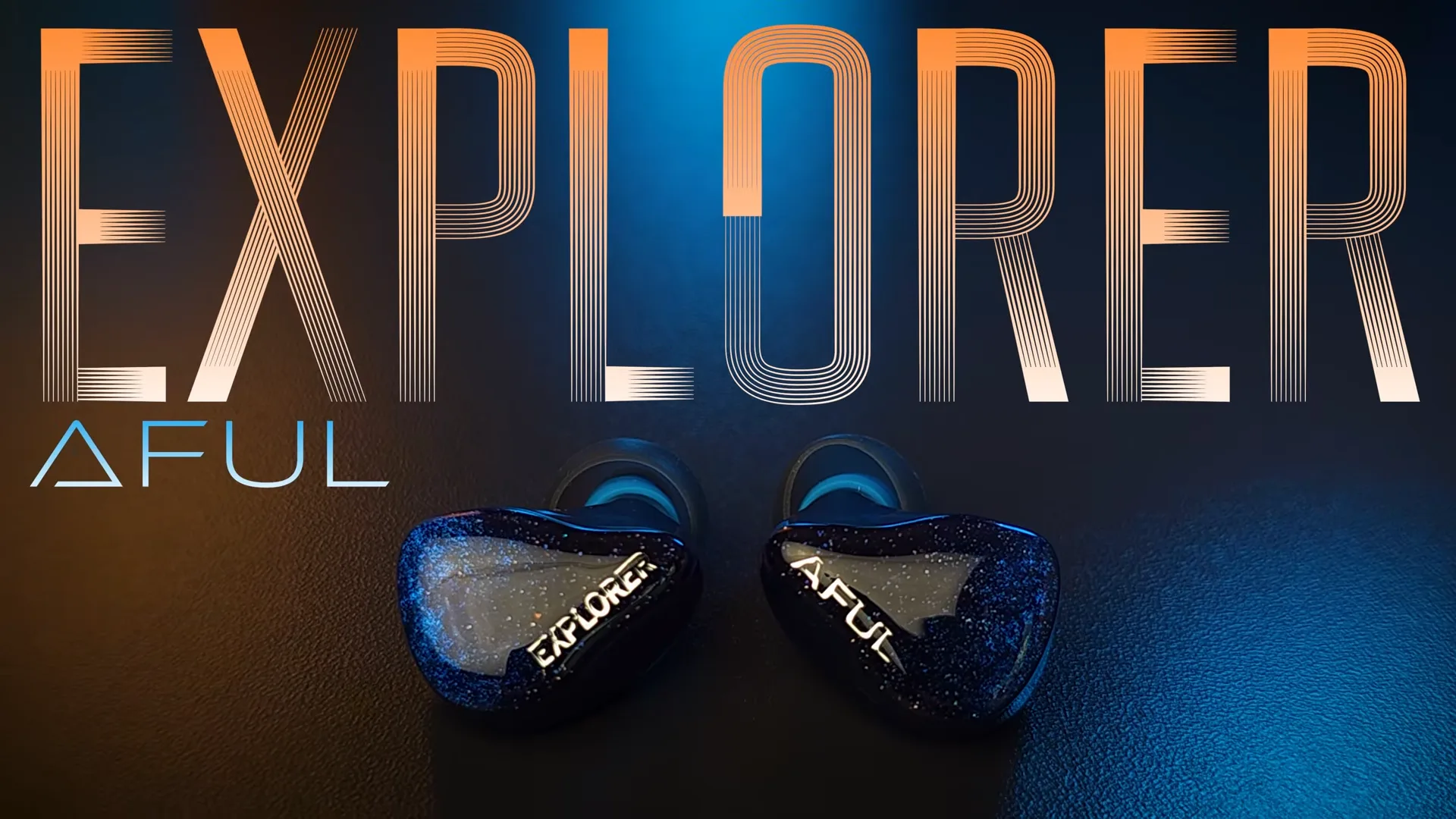
The Explorer is Aful’s latest IEM, and at $120, I believe it’s also their most affordable. Like most of their lineup, it’s a hybrid IEM featuring a dynamic driver for the bass paired with two balanced armatures. Scaled down from the four- and eight-BA setups in their pricier models. Honestly, I think this IEM is getting slept on. While Aful’s other sets are solid, they all share a very similar tuning philosophy: neutral with a sub-bass boost.
The Explorer is a complete departure, and a very welcome one. In fact, this is my favorite IEM they’ve made to date because it does something unique for the brand, and it does it remarkably well: bass. If you want a warm, bassy, relaxing set, this is for you; if you want a vocal-forward signature, look elsewhere.
AFUL Explorer Specifications
How I Tested the Aful Explorer
For the past few weeks, I’ve been living with the Aful Explorer as a daily driver, sleeping in it, and A/B testing it extensively against several benchmark IEMs in the $80 to $140 price bracket. I also measured its frequency response on my coupler rig (you can check it out on Squiglink) to see how the objective data lines up with what I hear in my ears.
- Source Gear & Cables: My review unit arrived with the 4.4mm balanced stock cable. Because I prefer single-ended connections for daily convenience, I did most of my portable testing by swapping in a standard 0.78mm 2-pin-to-3.5 mm cable plugged into my smartphone through a $10 Apple USB-C dongle. For desktop sessions, I used both the stock 4.4mm cable and my 3.5mm cable hooked up to my desktop DAC and amplifier rig.
- Music Tracks: I tested sub-bass extension and mid-bass slam with electronic tracks from Daft Punk and heavy rock drum mixes. Acoustic guitar transients and separation on Eagles’ Hotel California; and vocal placement across pop and indie acoustic recordings.
- Gaming Scenarios: I logged multiple evenings in Counter-Strike 2 (CS2), Valorant, and Apex Legends to test how the warm bass shelf and pulled-back upper midrange affect footstep localization during chaotic firefights.
Build Quality
Unboxing, Ear Tips & Carrying Case
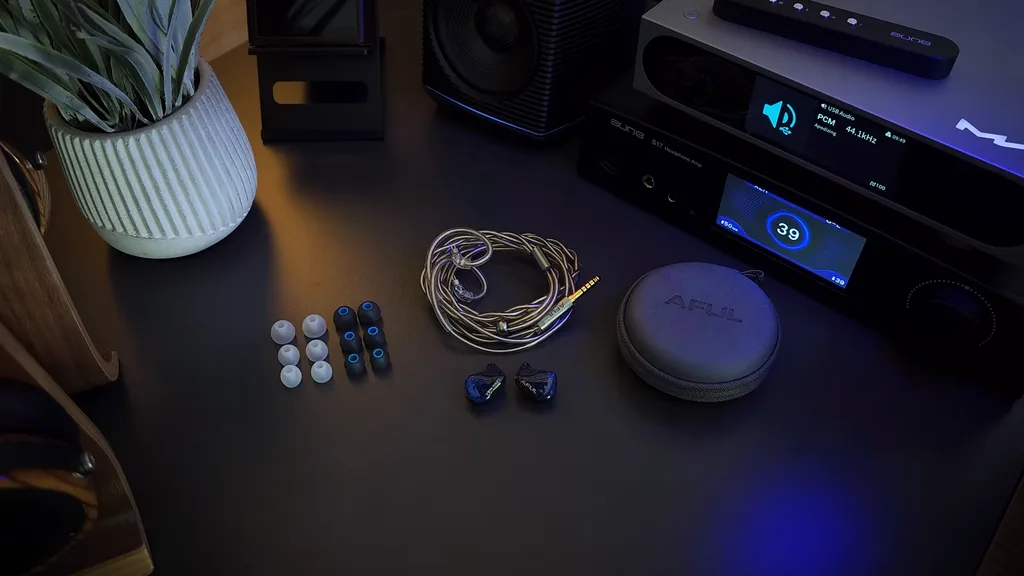
The packaging is simple, compact, and to the point, and it includes good-quality accessories for the $120 price bracket.
Starting with the ear tips, Aful includes two full sets of standard silicone tips: one completely clear set, and one clear set with a blue core. Aside from a slight difference in surface texture, they are functionally identical, so you’ll likely pick whichever color matches the IEM better in your eyes and I fully support that.
You also get a zippered carrying case that I really dig because of its functional, pocketable size. It fits the IEMs snugly and is wrapped in a matte, soft, rubberized material that emulates leather, with the brand name embossed on top. Inside, it has a felt lining and an internal mesh pocket to hold your spare tips.
Stock Cable & Connectors
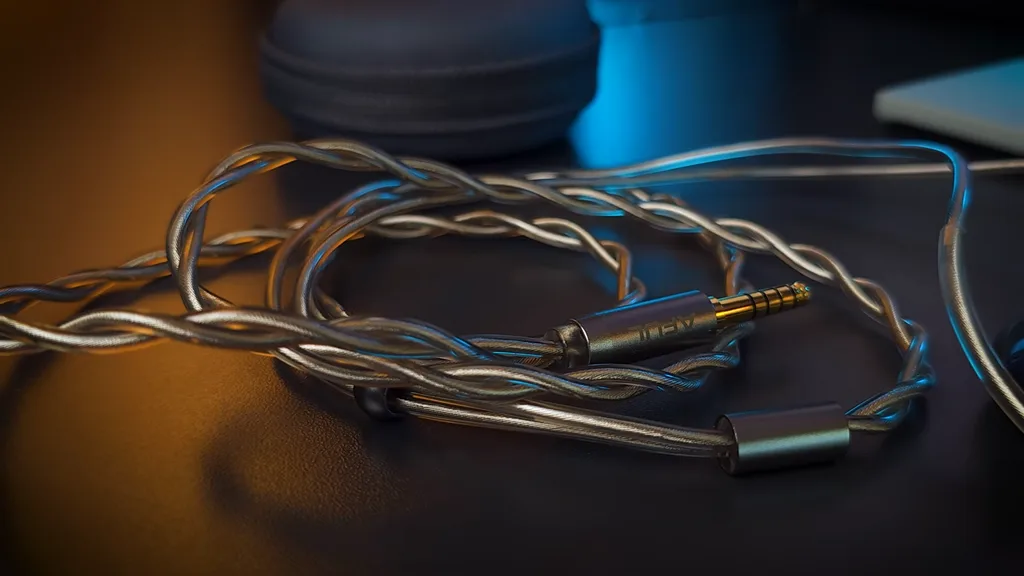
As Aful usually does, they’ve included a very nice stock cable. It’s slightly thick and barely memory-prone, but otherwise behaves really well. That extra thickness actually helps when “stancing” the IEMs for photos. The only reason I didn’t use the stock cable for my daily listening is that my review unit came with a 4.4mm balanced termination. You can order it with a 3.5mm single-ended plug, and I strongly encourage it because I think balanced is a meme though the 4.4mm option is there if you want it. The Y-split hardware is nice and small, the chin cinch stays in place (one of the best I’ve used), and it comes with pre-formed ear hooks and standard 2-pin connectors. The connectors on the earpieces are flush rather than recessed, meaning they will work with almost any aftermarket 2-pin cable.
Shell Design & Nozzle Build
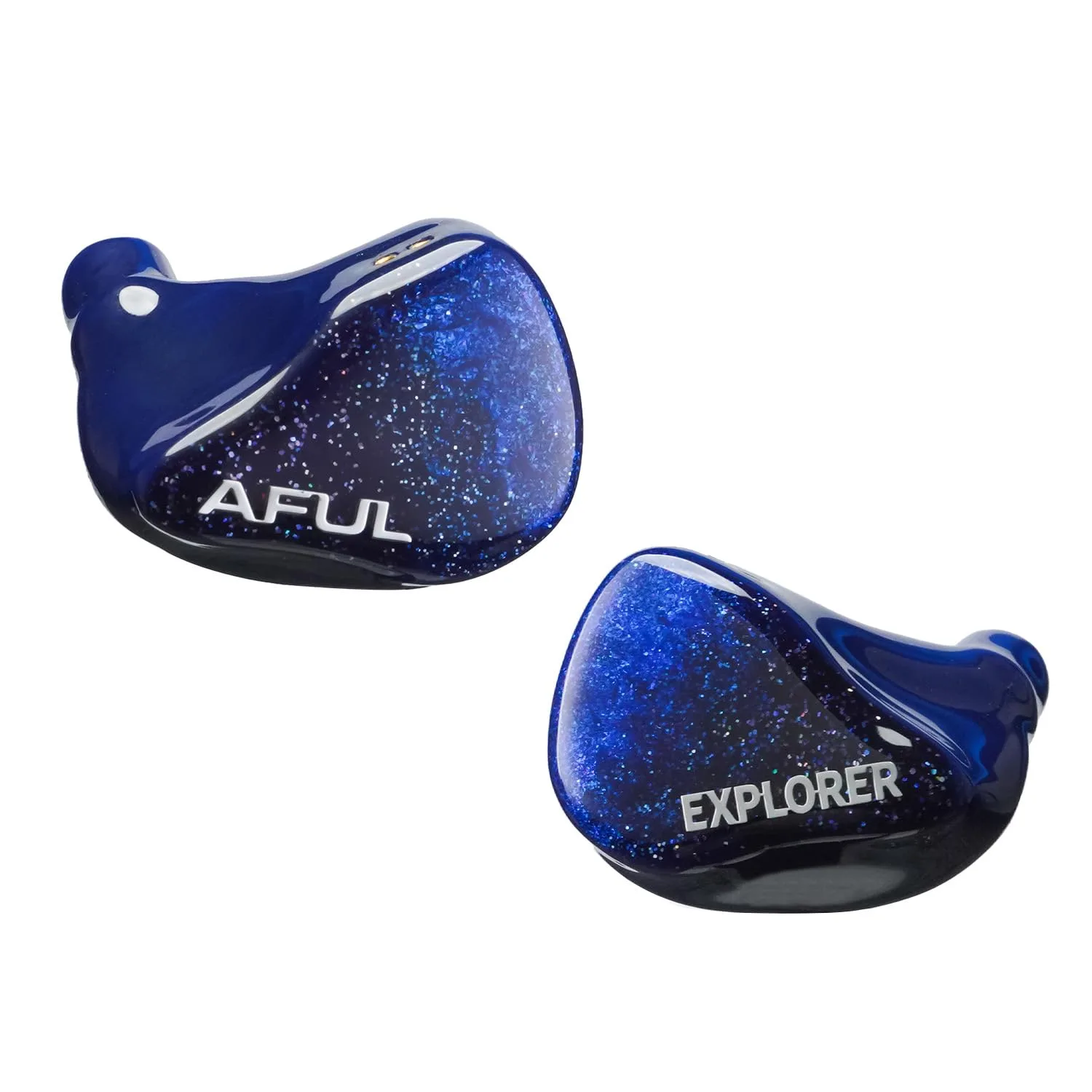
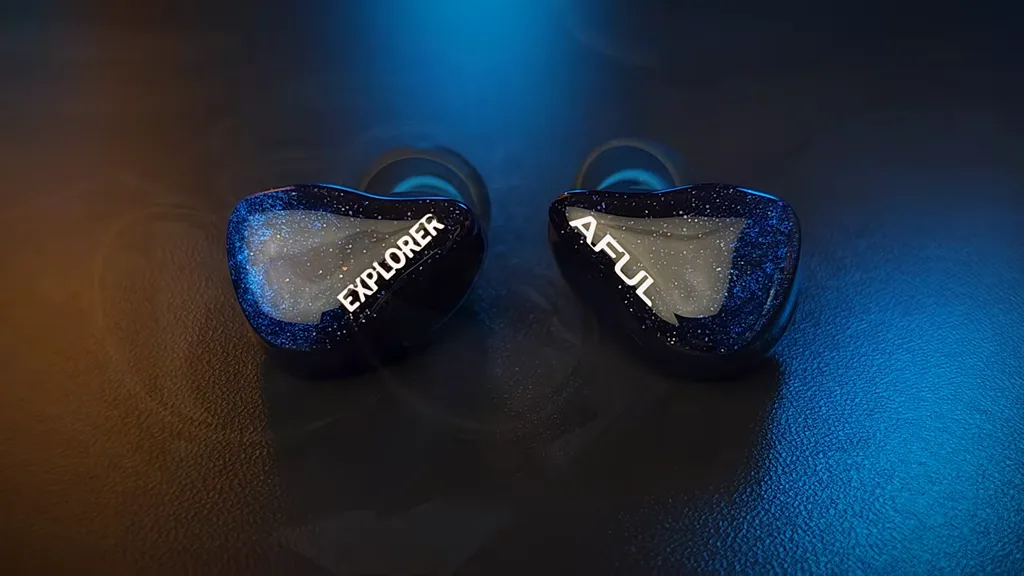
The earpieces themselves are handsome, entry-level acrylic shells with a medium-small, semi-custom shape. With a glittery faceplate, the design has nice visual depth that avoids looking gaudy and matches the cable aesthetically. Taking the ear tip off reveals a reasonable nozzle length. Like Aful’s other IEMs, there is no protective metal mesh screen over the nozzle tip; instead, you can see Knowles-style acoustic damper filters sitting directly inside the sound tubes.
Comfort, Fit & Isolation
The fit is easily one of my favorite things about the Explorer. Because of the medium-small footprint, it doesn’t crowd my concha bowl or create any outer-ear hotspot pressure. The semi-custom molding keeps it locked securely in place even when I’m sleeping, which I do regularly with my IEMs. It isolates aggressively well, and while the front vent for the dynamic driver prevents air pressure build-up for me, the tight seal means you might notice a slightly stronger occlusion effect than average if you’re sensitive to it. Overall, I love everything about the physicality of this IEM.
Sound Quality
The frequency response graph makes the AFUL Explorer’s sound quality clear: it is a warm, bassy IEM. It has a generous low-end elevation that, while focused in the sub-bass as is common today, doesn’t starve the mid-bass. Compared to the Harman target curve which is generally mid-bass light the Explorer skates comfortably above it, so the sound never feels thin.
Further up the graph, the upper midrange is noticeably relaxed. Because this region holds the meat of vocal presence, pulling it back below the target makes vocals sit further inside or slightly behind the mix rather than out in front.
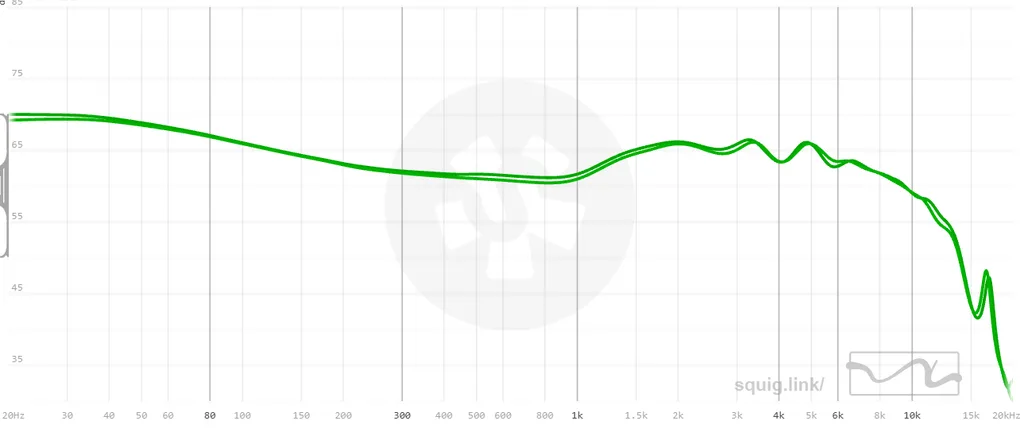
The treble graph also looks very smooth and appears rolled off in the upper air frequencies. However, in actual listening, it doesn’t sound rolled off at all. In fact, the treble timbre is one of the main reasons I like this IEM so much. Usually, I’m hesitant with heavy bass because it tends to come at the expense of clarity and treble detail. Here, the pulled-back upper midrange creates a “reverse masking” effect: because the upper mids aren’t shouting at you, the relaxed treble comes through with much more presence and clarity than the graph suggests. It’s still bass-dominant and slightly dark-leaning, but it never turns into an overly warm, muddy, or soupy mess.
Bass: Sub-Bass Rumble & Mid-Bass Punch
If you’re interested in the Explorer, you’re likely here for the bass and for good reason. No AFUL Explorer bass review is complete without highlighting this unique tuning: unlike AFUL’s leaner, neutral-tuned sets, the Explorer is warm, dense, and unapologetically bassy. The execution is fantastic. Because the tuning doesn’t solely rely on sub-bass rumble, you get a weighty, physical mid-bass punch. Kick drums land with a solid, satisfying impact that drives the rhythm of a track without bleeding over the rest of the mix.
Midrange & Vocal Clarity
Through the midrange, vocals are definitely on the relaxed, pulled-back side. If your primary goal is an intimate, vocal-forward presentation where singers take center stage, the Explorer isn’t the set for you. I like keeping a library of IEMs for different moods; while I wouldn’t reach for the Explorer strictly for vocal-centric acoustic tracks, its warm, lush midrange blends smoothly into the instrumental mix for an easygoing listen.
Treble: Sparkle Without Harshness
The Explorer’s treble execution is genuinely impressive. Despite looking tame on paper, it has just enough extra sparkle and bite to define transients sharply. This crispness cuts right through the heavy low end, giving the IEM a strong sense of clarity without ever resorting to strident, harsh, or sibilant peaks. It’s a fast, relaxed, and well-controlled top end that simply does its job.
Soundstage & Directional Imaging
Because the Explorer lacks a bright, airy treble boost, it doesn’t project the widest left-to-right stereo image. However, the fast transient response and weighty low end create strong front-to-back depth in the soundstage, making the presentation feel full and dimensional rather than flat.
Gaming Performance in CS2, Valorant & Apex Legends
While $120 isn’t pocket change, it sits squarely in the entry-level bracket of the audiophile IEM world. Even though I have access to a massive collection of much pricier gear, I’ve spent a disproportionate amount of time with the Explorer in my ears over the past few weeks. When it comes to gaming, the AFUL Explorer’s secure, zero-fatigue fit and non-strident treble make it effortless to wear for marathon sessions.
Its deep headstage and clean transient bite keep audio cues from turning into a blurry wall of sound. Is it the absolute best technical performer at this price for pinpoint stereo width? Not quite, if pure positional imaging is your number one priority, brighter sets from my best IEMs for gaming guide like the Simgot EM6L have an edge.. But for sheer enjoyment and long-session comfort, people are seriously sleeping on what the Explorer offers.
In Counter-Strike 2 (CS2) on Mirage, heavy utility like grenades and AWP shots sounded full and punchy without piercing my ears, though the elevated mid-bass warmth occasionally masked faint footsteps near A-site Ramp during chaotic firefights. In Valorant and Apex Legends, the smooth treble let me play three-hour ranked sessions with zero ear fatigue, even if the narrower left-to-right stereo width makes long-range directional tracking less clinical than brighter hybrids.
Comparisons
AFUL Explorer vs Truthear Hexa & MagicOne
To put the Explorer into context, I lined it up against three major competitors around its price bracket: the Aful MagicOne ($140, single BA), the Truthear Hexa ($80, 1DD + 3BA hybrid), and the venerable FiiO FH3 ($100–$130, 1DD + 2BA hybrid). In a direct AFUL Explorer vs Truthear Hexa comparison, the Explorer is clearly the warmer, bassier set. At the same time, the Hexa offers a calmer, warm-neutral presentation with less sub-bass emphasis and #1 vocal clarity.
AFUL Explorer vs FiiO FH3
Looking at the AFUL Explorer vs FiiO FH3, both share a 1DD + 2BA hybrid configuration, but the FH3 leans more into sub-bass bounce, with a livelier, brighter treble tilt and wider stereo imaging. The Explorer combines a lush, warm midrange tilt with a fun, bouncy sub-bass boost, feeling like a more polished evolution of the FH3.
Final Recommendation
If I were buying only one IEM in this bracket for myself, it would still be the Truthear Hexa. I’m a warm-neutral head at heart, and every time I A/B tested these four sets, I found myself getting stuck listening to the Hexa.
However, the Aful Explorer is easily my second pick. For a long time, I recommended the FiiO FH3 as the go-to sub-$150 bassy IEM. While the FH3 still holds an edge in stereo imaging, the Explorer feels like a much more polished, modern evolution of that fun tuning. The Explorer’s warm, punchy, yet clear signature is genuinely addictive and keeps drawing me back even after wrapping up this review. For an entry-level IEM, that staying power makes it a standout.
If you want a warm, bass-forward everyday tuning on a slightly tighter budget, you can also check out Kefine Delci vs Delci AE comparison, or step up to the Simgot SuperMix 4 if you want sharper positional gaming accuracy.
FAQs
Clear answers to common questions about performance, pairing, and value.