
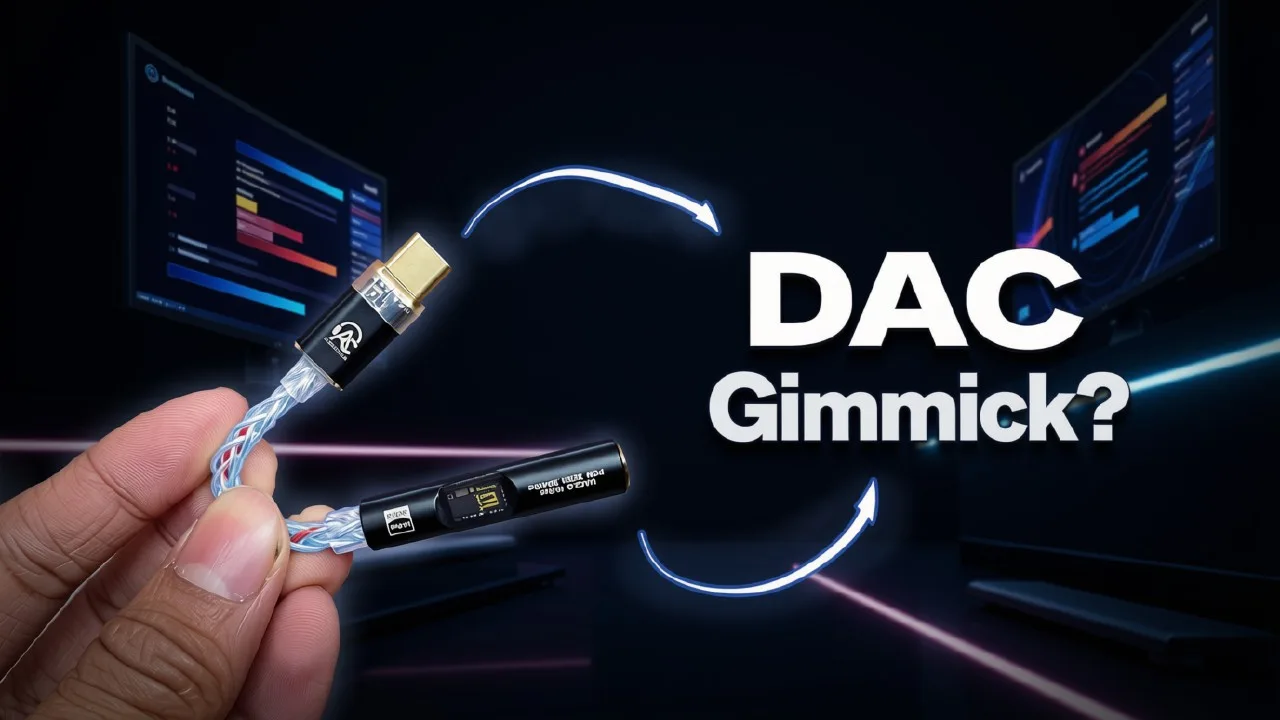
You read that right. Let me help you save some money. About a month and a half ago, I asked you guys which budget DACs I should review. The enthusiasm was huge. It took me some time to gather all the facts and do the review, but here we are with all of your DACs. We have everything from the Apple dongle to Audio Killer, FiiO, and 7Hz.
Let’s start with some basics: why do we need a DAC, and what are the myths around it? You only need a DAC in two conditions:
- Your current DAC is not sufficient to power your IEM or headphone.
- You want to decode hi-res music from your mobile phone.
In fact, some old phones already have a built-in hi-res DAC, like my old S10e, which I use as a DAP now. No other reason, seriously.
Also Checkout: 7 Best Budget IEMs in India
Common Myths About DACs
- Myth #1: A DAC can make your IEM sound better. That’s far from the truth. A DAC merely converts digital signals to analog. If you have a bad-sounding IEM, change your IEM—a DAC will not make it sound good. A DAC does not change the tonality of an IEM. If it does, it’s a bad DAC; something is wrong with it, it’s faulty, don’t go for it.
- Myth #2: You need a DAC to unleash the full potential of your IEM. What is an IEM’s full potential? It’s to provide you with good sound and technicalities. For that, an IEM needs power, not a miraculous DAC. How much power does it need? Not much. Most of your budget IEMs are good with your mobile jack—it’s just a marketing technique to sell you DACs. Thanks to Apple for removing the 3.5mm jack! Any mobile or laptop with a 3.5mm jack already has a built-in DAC.
An external DAC does not guarantee better sound. A superior DAC can provide slightly better resolution or realism on high-end IEMs or headphones, but it will never change the tonality of the IEM. That’s the misconception around it. Some people talk about DAC coloring—that if you have an IEM, some other DAC will make it sound good. No, it will not. It’s a myth. If you have a poor-sounding IEM, a DAC will not make it good. No amount of DAC changes or cable changes can improve it; do not waste your money on those gimmicks. Manufacturers will always say their product is best, claiming they can magically transform your experience. They won’t. Invest in IEMs—that will change your experience.
Experiment & Testing Setup
Initially, I wanted to do a review like I always do. However, I thought there’s a lot of fear-mongering around DACs—that without a DAC your IEM will sound poor, or that a good DAC can make your bass or treble good. How can I show this to you objectively?
I ran an experiment to see if there is any change in tonality when using a DAC. I took one IEM as a reference point and measured it. Everything I’m talking about is on my Squig so you can check it out yourself. Then I plugged the same IEM into all these different DACs—ranging from the Apple dongle to FiiO KA1 to iBasso DC07 Pro—to see how it changes the tonality. I wanted to see if there is any change at all. Here are the results.
Test Results & Tonality Analysis
Let’s start with the Apple dongle: very similar to the reference point (the IEM tuning). The only difference you see is in 20 to 30 Hz. It is there because of the Type-C interface I used, and it will be there across all DACs.
Now let’s check the 7Hz 71: same results as the Apple dongle. DC07, DC08, Headphone Zone DD5, JCally JM30, FiiO KA1—all show the same results. You will not see any difference in the tonality of the IEM.
Not convinced? I used some expensive DACs as well, like FiiO KA13 and iBasso DC07 Pro. All showed the same results. Did any DAC change any tonality? No, and it should not. If a DAC does, it is not a good DAC.
The Headphone Zone DD5 hi-res DAC and Audio Killer D07 DAC are the exact same DAC in terms of build quality, tonality, chip, and amplification—everything is similar. Check the frequency response: zero standard deviation. They are carbon copies of each other. Go with the cheaper one—it’s half the price and does the same job.
All the DAC tests I performed behaved almost identically. The only difference among them was power and a resolution factor that is almost negligible on budget IEMs.
Reiterating: if a DAC changes your tonality, it’s a faulty DAC. It has noise or distortion that is altering the tonality of your IEM. If you want to change the tonality of your IEM, EQ is the tool. The job of a DAC is to provide as pure a conversion as possible. With expensive DACs, you can get better resolution and technicalities, but only to the capacity of your IEM. It can never enhance the potential of your IEM beyond that.
Buying Recommendations
Which of these DACs is right for you?
- Apple Users: If you have an Apple device, get the Apple dongle. It’s the goat. The only problem with the Apple dongle is that it does not work well on Android—it doesn’t supply enough power for your IEMs. Only get the Apple dongle if you have an Apple device.
- Android Users: Two good options: Audio Killer D07 (one of the best dongles on the market, though not available globally) and FiiO JA1. FiiO JA1 has ample power to supply all my IEMs—I didn’t find a single IEM it couldn’t power—plus PEQ capabilities via the app for $10.
- Power-Hungry Setup: If you feel these three aren’t able to power your IEMs, the FiiO KA1 is amazing. It has enough power to drive some of my headphones.
To summarize:
- Apple device -> Apple dongle
- Android device -> FiiO JA1 or Audio Killer D07 ($10)
- Power-hungry IEMs/Headphones -> FiiO KA1
It’s that easy, seriously. Do not brainstorm much. Decision paralysis is always bad. Music is always good. Subscribe, support the channel, and I’ll see you in the next one!