


Both the KZ EDC Pro and KZ EDX Pro X sit in the same ultra-budget price bracket, with the EDX Pro X typically priced slightly lower, but they cater to different listening preferences: the KZ EDC Pro delivers a warm, balanced U-shaped signature with natural vocal presence and fatigue-free listening, while the KZ EDX Pro X provides an aggressive, bass-heavy V-shaped profile with deep sub-bass rumble and sharp treble sparkle for gaming.
Quick Buying Verdict
The KZ EDC Pro is the mature, balanced all-rounder. The KZ EDX Pro X is the aggressive, bass-heavy crowd-pleaser.
- Buy the KZ EDC Pro if you want a smoother, warmer sound, controlled bass, natural vocal weight, and zero ear fatigue during long listening or working sessions.
- Buy the KZ EDX Pro X if you prefer an energetic V-shaped tuning, hard-hitting sub-bass rumble, sharp treble sparkle, and aggressive audio cues for footstep tracking in CS2 and BGMI.
Technical Specifications Comparison
Features
Both the KZ EDX Pro X and KZ EDC Pro are analog wired in-ear monitors. They terminate in a standard 3.5mm audio jack and utilize detachable 0.75mm 2-pin (QDC-style) connectors, allowing you to easily replace or upgrade the detachable cable.
Because both models are purely passive wired earphones, they operate without any companion apps, batteries, or DSP software. Noise reduction is completely passive, relying on the physical acoustic seal created by the silicone ear tips.
How I Tested the KZ EDX Pro X & EDC Pro
I tested both IEMs over 7 days of daily use for both competitive gaming and music listening, ensuring the findings reflect long-term acoustic behavior rather than a brief first-listen impression.
- Audio Sources: Driven directly via standard 3.5mm laptop output and an Apple Type-C Dongle (CX31993 DAC) on mobile to check scaling and background hiss.
- Ear Tips Used: Tested with stock silicone tips first, then switched to KZ Starlines (Medium) to ensure a proper acoustic seal for low-end evaluation.
- Test Tracks: Evaluated using “Bad Guy” by Billie Eilish (sub-bass extension & rumble), “Hotel California” by Eagles (acoustic mid-range & vocal separation), and “Blinding Lights” by The Weeknd (treble brightness & percussion snap).
- Gaming Tests: Played consecutive matches in CS2 and Valorant to test directional audio imaging, spatial depth, and whether explosion bass masked subtle footstep cues.
- Listening Sessions: Continuous 60 to 90-minute sessions to gauge treble fatigue, sibilance, and ear canal pressure.
- Volume Matching: Matched to approximately 72–75 dB listening levels across both units to ensure fair A/B comparison.
Both units were purchased independently for this review. GeekHunk earns an affiliate commission through qualifying Amazon links, which does not alter our editorial testing or final verdict.
Sound Signature Breakdown
I tested both sets across several days using my standard test tracks and daily gaming sessions, driven primarily through a standard 3.5mm connection and an Apple Type-C dongle. Both use a single 10mm dynamic driver setup, but they are tuned with two completely different targets in mind.
The KZ EDX Pro X stays true to the classic, aggressive KZ V-shaped house sound. The KZ EDC Pro shifts toward a balanced, warmer U-shaped profile that prioritizes tonal balance over raw, in-your-face energy.
Bass Response
The lower register is where the contrast between these two is immediately obvious.
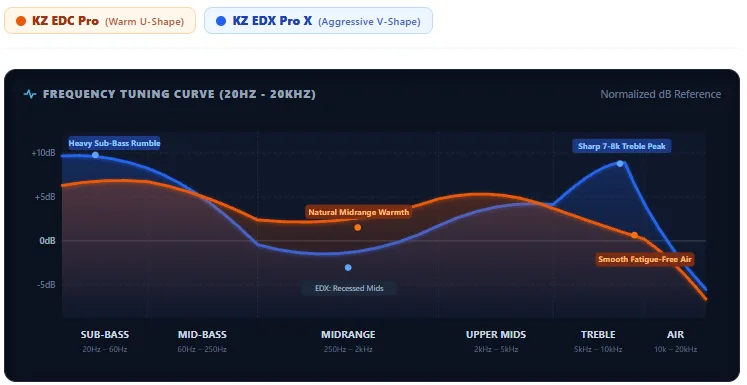
On the KZ EDX Pro X, the low end hits with noticeable authority. The emphasis leans heavily into the sub-bass rumble, backed by a hard-hitting mid-bass slam. On bass-heavy electronic tracks and hip-hop beats, you get a physical punch that vibrates with genuine impact. The trade-off is control. During fast, complex bass passages, the low end can feel slightly loose and bleeds into the lower midrange, which can mask subtle bass-guitar textures.
The KZ EDC Pro handles bass with far better discipline. Instead of overwhelming your ears with sheer volume, it delivers a tight, punchy mid-bass with clean sub-bass extension. On rock and acoustic tracks, kick drums thud with satisfying snap, and basslines remain distinct rather than turning into a wall of low-frequency hum. It does not provide the skull-rattling rumble of the EDX Pro X, but the speed, decay, and texture are noticeably cleaner.
Midrange Clarity
Midrange performance reveals just how much KZ matured with the EDC Pro.
The KZ EDX Pro X has a noticeably recessed midrange. Male vocals sit a step behind the mix, and lower-mid instruments like rhythm guitars can sound slightly hollow or pushed back. KZ lifted the upper midrange around 3 kHz to keep female vocals audible, but this creates a somewhat thin note weight. On busy tracks with overlapping instruments, vocal intelligibility drops, making the overall presentation feel crowded.
In contrast, the KZ EDC Pro delivers a far more natural, forward midrange. Vocals have realistic warmth and body without sounding thick or chesty. Acoustic guitars retain proper resonance, and pianos sound natural rather than metallic. When listening to acoustic vocal tracks, the separation between the singer and backing instruments is distinct, giving you a level of coherence that is rarely found in sub-$10 IEMs.
Treble Quality
Treble execution is usually the make-or-break factor for ultra-budget KZ IEMs, and these two handle high frequencies very differently.
The KZ EDX Pro X pushes a bright, energetic top end with boosted presence in the 6 kHz to 8 kHz region. This tuning creates an immediate sense of clarity and artificial air, making cymbal crashes and snare snaps jump out. However, that sharpness comes at a cost. At higher listening volumes or on poorly mastered tracks, sharp ‘s’ and ‘t’ sounds trigger noticeable sibilance. It can become fatiguing to my ears after an hour of continuous listening.
The KZ EDC Pro takes a much safer, smoother approach. The treble is well-extended but rolled off just enough to eliminate harsh metallic glare and peaky sibilance. You still get adequate detail to pick up hi-hat patterns and room decay, but without the piercing bite. The detail retrieval is not hyper-resolving, but it is musical, fatigue-free, and comfortable for extended listening sessions.
Gaming Performance
For competitive tactical shooters, each IEM brings a specific trade-off to the table.
In CS2 and Valorant, the KZ EDX Pro X gives you a slightly wider lateral soundstage due to its elevated upper frequencies and vented shell. The sharp treble spike acts like a built-in EQ cheat for audio cues: gunshot snaps, weapon reloads, and enemy footsteps in quiet 1v1 situations cut through cleanly. The downside appears in chaotic moments. When an HE grenade detonates or multiple abilities pop on Ascent A-site, the boomy bass rumble easily drowns out subtle directional footstep audio.
The KZ EDC Pro provides a tighter, more intimate soundstage, but its positional imaging and vertical layering are more consistent. Because the bass is tighter and does not mask the midrange, tracking footsteps through gunfire remains reliable in BGMI and CS2. The tamer treble also means flashbang rings and close-range Vandal or AK sprays do not tear through your eardrums at competitive volumes.
If your priority is pure acoustic realism, balanced vocals, and fatigue-free listening, the KZ EDC Pro is the clear winner here. If you want maximum sub-bass rumble and sharp, snappy sound cues for casual gaming, the KZ EDX Pro X still has its place.
Design & Build Quality

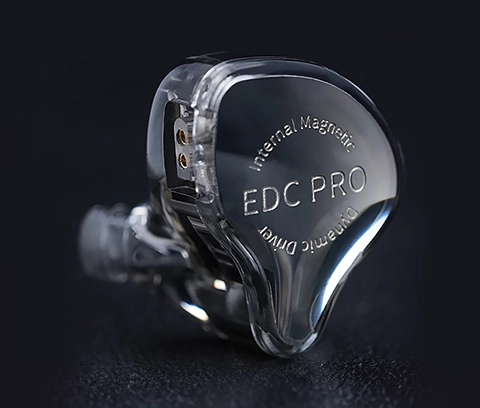
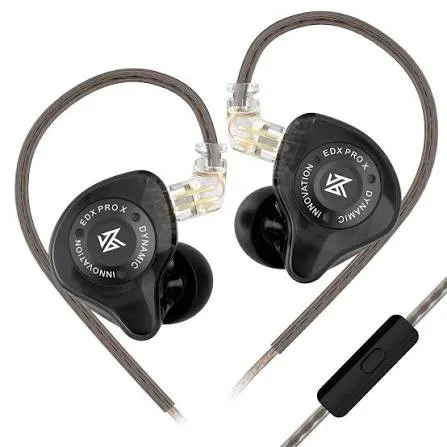
Both the KZ EDC Pro and EDX Pro X use injection-molded resin shells, making them lightweight and durable. The EDC Pro stands out with its mirror-finish top plate, giving it a sleek and reflective design. However, the EDX Pro X feels more refined, with its slightly more premium build and enhanced design details.
Both IEMs feature 0.75mm 2-pin (QDC-style) connectors, improving cable compatibility and durability.
Comfort & Fit
Both IEMs utilize lightweight resin shells that sit flush in average-sized conchas. However, the KZ EDC Pro is better suited for marathon listening sessions due to its fatigue-free acoustic tuning. Its smooth high-frequency roll-off prevents ear strain. While the KZ EDX Pro X provides a secure physical seal, its intense treble peaks and heavy sub-bass slam can cause listening fatigue after 60 to 90 minutes.

Value for Money
Both IEMs sit in the same ultra-budget bracket, with the EDX Pro X typically priced slightly lower than the EDC Pro. At virtually identical sub-$15 price points, your buying decision depends strictly on sound signature preference.
- Choose the KZ EDC Pro if you want acoustic balance, rich vocal timbre, and all-day musical enjoyment.
- Choose the KZ EDX Pro X if you want maximum sub-bass rumble for EDM and hip-hop, or heightened treble sharpness to isolate enemy footsteps in CS2 and BGMI.
💡 Confused between the older and newer EDX models? Read our detailed breakdown: KZ EDX Pro vs KZ EDX Pro X: Differences & Worth Upgrading? →
Final Verdict: EDC Pro vs EDX Pro X
If you want a smoother, warmer sound with rich sub-bass and zero fatigue for long listening sessions, go with the KZ EDC Pro. If you want sharp treble, high micro-detail, and precise footstep audio for competitive gaming, the KZ EDX Pro X is the better pick.
Frequently Asked Questions
Clear answers to common questions about performance, pairing, and value.


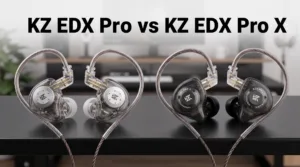
[…] KZ’s newer single-driver releases offer a warmer vocal tone, as seen in our KZ EDX Pro X vs KZ EDC Pro comparison. […]